📌 Key Takeaways
Sharps containers are essential for safely collecting needles, syringes, lancets, scalpels, and other sharp medical waste while reducing needlestick injuries and exposure to bloodborne pathogens. They should be puncture-resistant, leak-proof, properly labeled, and placed close to where sharps are used. Sharps must be disposed of immediately without recapping, and containers should be sealed and replaced when about three-quarters full. Proper disposal also requires following OSHA, FDA, EPA, and applicable state requirements. Choosing the right container size, training staff, and using a compliant disposal provider helps healthcare facilities maintain safety and regulatory compliance.
Sharps containers are one of the most important tools for preventing injuries and ensuring safe medical waste disposal. Whether in hospitals, dental offices, laboratories, veterinary clinics, or home healthcare settings, these specially designed containers provide a secure way to dispose of needles, syringes, lancets, scalpels, and other sharp medical instruments that could cause injury or spread infection if handled improperly.
It only takes one improperly discarded needle to create a serious safety risk. A used syringe tossed into a regular trash bag instead of a designated sharps container can expose healthcare workers, sanitation staff, or even family members to accidental needlestick injuries and bloodborne pathogens. That’s why proper sharps disposal isn’t just a best practice-it’s an essential part of workplace safety and regulatory compliance.
In this guide, you’ll learn what sharps containers are, what can and cannot be placed inside them, how to choose the right container, proper disposal methods, and the key regulations every healthcare facility should follow to maintain a safe and compliant environment.
Why Are Sharps Containers Essential?
A sharps container, at its core, is a puncture-resistant, leak-proof bin built for exactly one job – holding used needles, syringes, and other sharp medical waste until it can be treated or destroyed properly. Simple idea. Somehow still easy to get wrong in the day-to-day. According to Mordor Intelligence, the sharps containers market was valued at USD 65.57 million in 2025 and is projected to grow from USD 68.79 million in 2026 to USD 87.42 million by 2031, registering a CAGR of 4.91% during the forecast period (2026–2031).
Firstly, they protect whoever’s doing the disposing. Most needlestick injuries, oddly enough, don’t happen during the actual procedure. They happen after – during cleanup, or when someone reaches into a spot they really shouldn’t have to. Additionally, containers protect people further down the chain: housekeeping staff, waste haulers, basically anyone who might cross paths with sharps medical waste that was tossed somewhere it shouldn’t have been.
A handful of reasons these matter more than people tend to assume:
- They cut needlestick injuries significantly when placed right at the point of use, not down the hall somewhere
- They stop bloodborne pathogens – Hepatitis B, Hepatitis C, HIV – from spreading through exposure that’s almost always avoidable
- They keep facilities inside OSHA’s Bloodborne Pathogens Standard, which spells out containment requirements pretty explicitly
- They protect the public and the environment once the waste actually leaves the building
This gets overlooked a lot – this isn’t purely a hospital problem. Dental offices, tattoo studios, vet clinics, and many households managing diabetes or similar conditions generate real sharps waste disposal needs regularly. The FDA’s own guidance on using sharps safely at home makes it pretty clear how far this problem extends past clinical walls.
What Can Be Disposed of in Sharps Containers?
This one trips people up more than you’d guess. A sharps container isn’t a catch-all for “anything vaguely medical looking.”
What actually belongs inside:
- Needles and syringes
- Lancets from blood testing
- Auto-injectors – insulin pens, epinephrine pens, that sort of thing
- Scalpels and blades
- Broken glass or plastic from lab or clinical work
- Infusion and connection sets that still have a needle attached
What doesn’t belong, despite what some staff genuinely assume:
- Medication and empty pill bottles
- Bandages, gauze, alcohol prep pads
- Batteries
- Paper waste, general trash
- Chemical or radioactive waste – that’s a separate regulated category entirely, don’t mix it in
Sorting this correctly matters for cost almost as much as safety, honestly. Facilities that misclassify regular trash as sharps waste, or the reverse, end up either overpaying for disposal or creating a real hazard for the next person who touches that bag.
How to Use a Sharps Container Correctly
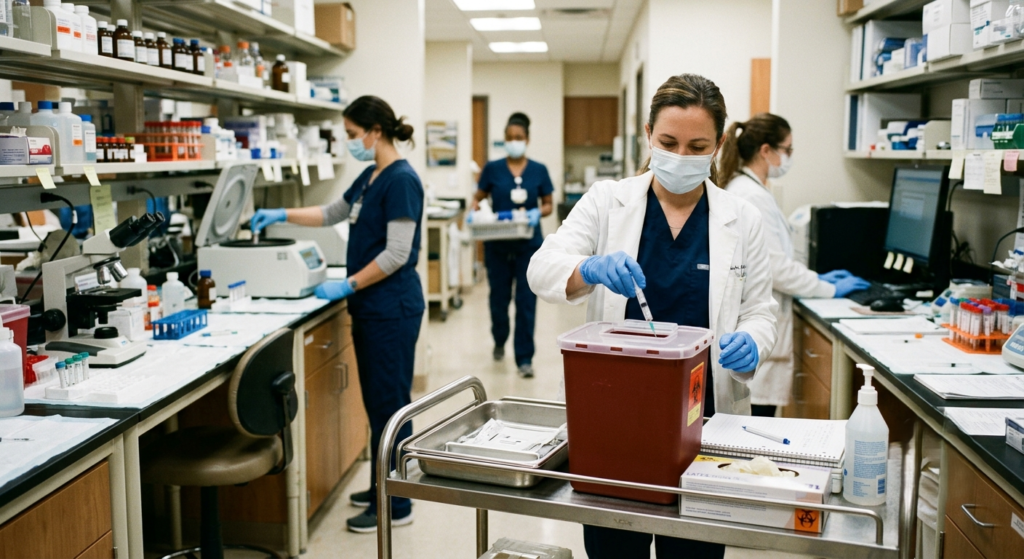
Nothing complicated here, but a few habits genuinely matter. Drop sharps in right after use, point-first, and skip the recapping – recapping needles is, weirdly enough, one of the leading causes of injuries in the first place. Don’t force anything into an opening that’s too small for it. And stop adding to the container once it hits the three-quarters line. Not when it’s visibly spilling over. Before that.
How to Dispose of a Full Sharps Container
Once a container hits that three-quarter mark, treat it as finished. Seal the lid fully – if it’s a mailbox-style or locking design, make sure it actually clicks into the sealed position instead of just resting shut, which people assume counts, and it really doesn’t.
The general process most facilities follow looks something like this:
- Seal the container with its built-in locking mechanism
- Label it with the seal date, plus whatever facility identifiers your local rules require
- Store it upright somewhere secure, away from regular foot traffic, until pickup
- Arrange collection through a licensed sharps disposal services provider, or use an approved drop-off or mail-back program
Most states give you up to 30 days from the seal date to complete disposal, though that window shifts by region, so it’s worth double-checking your local health department directly rather than assuming. For anyone without a facility program, the FDA also lays out approved community disposal options, including drop boxes at pharmacies and hospitals.
One thing worth saying flat out: never put a sharps container in with regular household or office trash. Sealed or not, it doesn’t matter. It’s not just a rule on paper – it’s genuinely dangerous for whoever ends up handling that bag next, and that’s usually someone who never signed up for that risk.
Regulations and Compliance for Sharps Disposal
A handful of agencies have a say in how sharps containers get designed, placed, and eventually disposed of, and it’s worth knowing the basics instead of just assuming your supplier’s got it fully handled.
OSHA covers workplace safety – container labeling, placement near the actual point of use, employer training obligations, all of it. The FDA regulates the containers themselves, requiring leak resistance, puncture-resistant lids, and proper hazard labeling before anything can even go on the market. The EPA and various state environmental agencies weigh in on how the waste gets transported and treated once it’s out the door, usually under hazardous waste frameworks like RCRA.
Moreover, compliance here isn’t just paperwork nobody reads. Facilities that cut corners tend to face real consequences eventually – fines, failed inspections, and in the worst cases, actual injuries that a properly placed container and a little staff training would’ve prevented outright.
Conclusion: Protect Health with Proper Sharps Disposal
Sharps containers do their job quietly, right up until the one moment they don’t, and that moment is almost always preventable if you’re being honest about it. Get the sizing right. Place containers where people actually need them, not just where it’s convenient to mount one. Train staff on what belongs inside. Stick to a real disposal schedule instead of waiting for something to overflow.
Frequently Asked Questions
What are sharps containers used for?
They’re used to safely collect and store used needles, syringes, and other sharp medical items until proper disposal or treatment happens.
What are the different sharps container sizes available?
Sizes run from small, one-quart containers meant for home or travel use up to several-gallon containers built for high-volume clinical settings.
How do I choose the right sharp container for needles?
Base it on how much waste you generate, how often you’ll be swapping containers, and the largest sharp you regularly use – the opening has to fit it safely.
Can syringe boxes be used instead of sharps containers?
Only if they actually meet FDA safety standards for puncture resistance and secure closure. A standard box without those features isn’t a real substitute.
Why choose MedCycle for Sharps Disposal Services?
MedCycle handles scheduled pickups, compliant processing, and container sizing for everything from small clinics to full hospital systems – basically taking the guesswork out of staying compliant.