📌 Key Takeaways
Infectious waste management encompasses a plethora of topics that range from identifying the types of infectious waste to their storage, treatment, and transportation in accordance with state and federal regulations. The former encompasses a set of rules regarding the isolation of healthcare waste, which, if not followed, renders the whole operation ineffective, as mixed waste requires more rigorous treatment as if all of it were contagious. Below are some of the topics related to infectious waste that are covered by this course.
Effective infectious waste management starts with proper identification, segregation, storage, treatment, and documentation of regulated waste. A single red bag mixed into regular trash can turn an entire dumpster into a regulated waste problem. That’s the part most people outside healthcare never think about: infectious waste management isn’t really about the scary stuff used sharps, contaminated dressings. It’s about the boring discipline of keeping that waste separated correctly from everything else, every single time. Working with a reliable medical waste disposal company can help healthcare facilities maintain proper segregation, collection, and handling practices while reducing the risk of costly compliance issues.
What Is Infectious Waste?
Infectious waste is material capable of transmitting disease, typically because it’s contaminated with blood, bodily fluids, or pathogens. Not every item that touches a patient qualifies, and that distinction trips up a lot of facilities early on.
Blood-soaked bandages, cultures from a microbiology lab, and used sharps all fall clearly into this category. A used tissue or an empty medication bottle usually doesn’t, even though both technically touched a sick person. The line comes down to whether the item is saturated with, or likely to release, infectious material, not simply whether it was near one.
Understanding what qualifies as infectious waste is the foundation of effective infectious waste management in healthcare facilities.
Categories Within Infectious Waste
Properly identifying each waste category is an important part of infectious waste management because different materials may require different handling and treatment methods.
Pathological waste, human tissue and organs from surgery or autopsy, is handled separately from general infectious waste due to both safety and disposal method differences. Sharps waste disposal guidelines cover needles, scalpels, and broken glass specifically, since these carry injury risk on top of infection risk. Cultures and stocks from labs, along with any equipment used to transfer or mix them, count as infectious waste too, often requiring the strictest handling of any subcategory.
Legal & Regulatory Overview
Medical waste regulations layer federal guidance on top of state-specific rules, and the gap between states is bigger than most people expect when walking into this field.
Following federal and state requirements is a central part of infectious waste management, particularly for facilities responsible for regulated healthcare waste.
At the federal level, OSHA’s Bloodborne Pathogens Standard governs how healthcare workers handle infectious waste on the job, covering everything from required protective equipment to sharps containers specifications. The EPA weighs in on treatment and disposal methods, particularly around incineration emissions. States then add their own layer, licensing requirements for haulers, specific storage time limits, and documentation rules that vary enough that a multi-state healthcare system genuinely needs a compliance person tracking it all.
Why Compliance Documentation Matters
Maintaining accurate manifests and records strengthens infectious waste management by providing a clear record of how waste moved from generation through final treatment. A facility that can’t produce a manifest showing where its infectious waste went, and how it was treated, is exposed during any inspection, regardless of whether the waste was actually handled correctly. Paper trails matter here almost as much as the physical process itself.
Treatment Options Explained
Infectious waste disposal generally comes down to a handful of proven treatment methods, each suited to different waste types and facility sizes. Selecting an appropriate treatment method is a key component of infectious waste management, since waste types, facility needs, and regulatory requirements can differ.
Autoclaving uses high-pressure steam to sterilize waste, typically running at temperatures around 250°F for a set period long enough to kill pathogens. It works well for most general infectious waste and sharps, though it doesn’t reduce the physical volume much, waste still needs disposal afterward, just without the infection risk attached.
Incineration destroys waste through high-temperature burning, reducing both volume and infection risk simultaneously. It remains the standard for pathological waste and certain pharmaceutical waste that cannot be adequately treated through autoclaving, making proper pharmaceutical waste disposal essential. Emissions regulations have tightened considerably over the past two decades, which has pushed the cost of incineration up relative to autoclaving for waste types where either method works.
- Autoclaving: sterilizes through steam, minimal volume reduction, lower cost
- Incineration: sterilizes and reduces volume, required for pathological waste, higher regulatory burden
- Chemical treatment: used for liquid waste streams, less common for solid infectious waste
- Microwave treatment: shreds and sterilizes simultaneously, growing in use but not yet universal
Choosing the Right Method
Facility size and waste type usually dictate the choice more than cost alone. A small clinic generating mostly sharps and general infectious waste rarely needs incineration capacity, while a hospital handling pathological waste from surgery may have no real alternative for that specific stream. Working with experienced clinical waste contractors can help facilities determine the most appropriate treatment and disposal methods based on their waste streams, regulatory requirements, and operational needs.
Storage, Transport, and Off-Site Disposal
Healthcare waste segregation at the point of generation determines how smoothly everything downstream actually goes. Get this step wrong, and a facility ends up paying to treat far more waste as infectious than actually needs to be. According to Grand View Research, the U.S. medical waste management market was valued at approximately USD 9.17 billion in 2025 and is expected to grow to USD 15.26 billion by 2033, reflecting a 6.39% CAGR between 2026 and 2033.
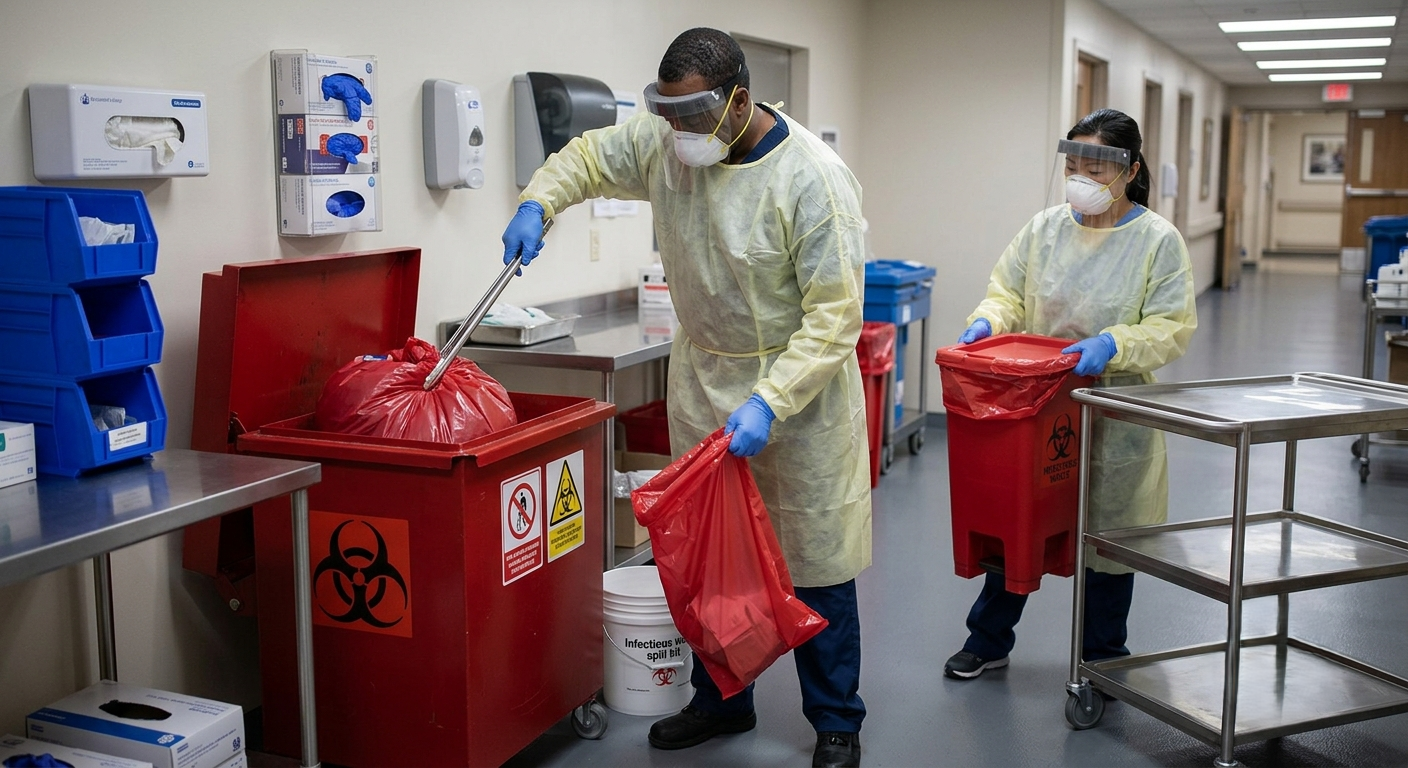
Color-coded, leak-resistant containers separate infectious waste from general trash the moment it’s generated, red bags being the near-universal standard. Storage areas need restricted access and, depending on state rules, a maximum holding time before pickup, often somewhere between three and thirty days depending on the waste type and local climate.
Transport and Chain of Custody
A licensed hauler transports waste to a treatment facility, and every step gets documented through a manifest system tracking the waste from generation through final treatment. This isn’t paperwork for its own sake. If a facility ever faces an inspection or a liability question, that manifest is the only proof that the waste was actually handled properly.
Reducing Volume Without Cutting Corners
Waste minimization matters more than people initially assume, both for cost and for environmental impact. Segregating correctly at the source prevents non-infectious waste from getting swept into the infectious stream unnecessarily, which is often the single biggest lever a small clinic has for reducing disposal costs without cutting any actual corners on safety.
Conclusion: Importance of Proper Infectious Waste Management
Infectious waste management isn’t complicated in concept: identify it correctly, store it properly, treat it appropriately, and document the whole chain. What trips facilities up is consistency one mixed bag, one skipped log entry, and the whole system’s integrity comes into question. Getting segregation right at the point of generation solves more problems downstream than any treatment method ever could on its own. For facilities seeking reliable medical waste disposal Houston services, maintaining proper segregation and handling practices is essential, and it’s the one part of this process every staff member, not just the compliance officer, has a hand in.
FAQs
What counts as infectious waste?
Blood-soaked materials, used sharps, lab cultures, and pathological waste all qualify, generally defined by whether an item is saturated with or likely to release infectious material.
How should sharps be disposed of safely?
Sharps belong in puncture-resistant, labeled containers immediately after use, filled no more than three-quarters full before sealing and sending for treatment through a licensed provider.
Can infectious waste be autoclaved instead of incinerated?
Yes, for most general infectious waste and sharps, though pathological waste and certain pharmaceutical items typically still require incineration due to the nature of the material.
How long can infectious waste be stored on-site?
Storage limits vary by state, generally ranging from a few days to about a month, depending on the waste type and how the facility’s storage area is set up.
How can small clinics reduce infectious waste volume?
Careful segregation at the point of generation, avoiding mixing non-infectious trash into red bags, is typically the most effective and lowest-cost way to reduce overall volume.
Why choose MedCycle for Infectious Waste Management?
MedCycle handles collection, treatment, and full documentation for infectious waste, giving facilities a compliant, traceable process without needing to manage every regulatory detail internally.