📌 Key Takeaways
EPA compliance is an important part of responsible medical waste management, especially when facilities handle hazardous waste streams such as pharmaceutical and chemotherapy waste. This guide explains key EPA and RCRA requirements, including waste segregation, labeling, documentation, storage, and staff training. It also covers potential fines and the consequences of improper medical waste disposal. By maintaining accurate records, training staff, and working with reliable waste disposal providers, healthcare facilities can reduce compliance risks and avoid costly violations.
EPA compliance for medical waste sounds straightforward, right up until a facility actually gets audited. Rules split across federal and state agencies. Fines that stack from multiple directions at once. Requirements that shift depending on which waste stream is involved. Most violations aren’t even intentional. They trace back to a training gap, a missing document, or a vendor mistake nobody caught in time. Strong EPA compliance practices can help facilities catch these issues before they turn into costly violations.
Here’s a number worth sitting with: EPA medical waste fines can run up to $75,000 per day, per violation, under the Resource Conservation and Recovery Act. In fiscal year 2025 alone, the agency completed over 2,100 civil enforcement cases and assessed more than $650 million in penalties across industries. Not a scare tactic. Just where enforcement sits right now.
I’ve spent years covering healthcare operations and regulatory compliance, and this exact topic comes up constantly, especially from smaller practices assuming it only applies to hospitals. This guide breaks down what EPA regulations actually cover, the medical waste disposal laws worth knowing, what triggers fines, and how to keep a facility on the right side of all of it.
Understanding EPA Regulations for Medical Waste
Here’s something that surprises many people: the EPA no longer directly regulates most medical waste. However, EPA compliance still matters when a facility handles hazardous waste streams regulated under federal environmental laws. The Medical Waste Tracking Act of 1988 expired back in 1991, and since then, state environmental and health departments have taken over as the primary regulators for infectious “red bag” waste.
That said, the EPA hasn’t stepped away entirely. Under RCRA, the agency still regulates hazardous waste, and certain medical waste streams fall squarely under that jurisdiction. Pharmaceutical waste and chemotherapy waste are the big ones. That’s where those headline EPA fines actually come from. According to the World Health Organization, only 61% of hospitals had access to basic health-care waste management services in 2021. The situation is even more critical in fragile settings, where 2023 data shows that just 25% of health facilities had access to basic health-care waste management services.
Firstly, it helps to understand this is a layered system, not a single agency handing down one set of rules. A single compliance failure can trigger penalties from multiple directions at once:
- EPA and RCRA, up to $75,000 per day for hazardous waste violations
- OSHA, up to roughly $15,625 per day for worker safety violations
- DOT, penalties reaching into the hundreds of thousands for transport violations
- HIPAA, if patient waste records or privacy protections get compromised along the way
Understanding these overlapping requirements is an important part of maintaining EPA compliance, particularly for facilities that handle pharmaceutical, chemotherapy, or other potentially hazardous waste streams. Air quality standards fall under EPA oversight too, particularly for facilities using incineration to treat certain waste types. Incinerators release pollutants like dioxins and heavy metals, so the EPA mandates pollution-control technology and regular emissions monitoring for facilities using that method.
Medical Waste Disposal Laws You Should Know
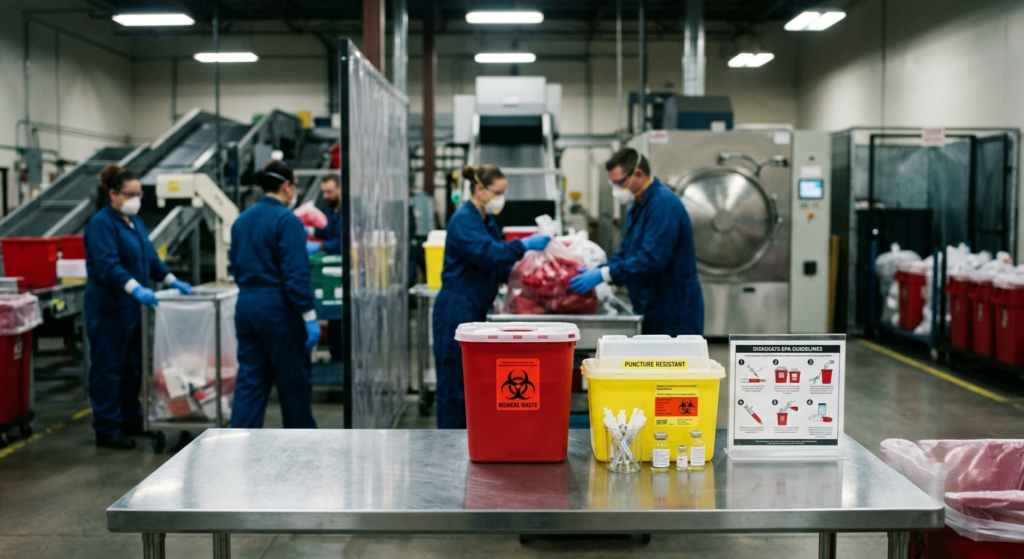
Medical waste disposal laws vary by state, but a handful of federal baseline requirements show up almost everywhere. Maintaining EPA compliance requires facilities to understand both federal requirements and the state-specific rules that apply to their waste streams.
Waste Segregation Requirements
Improper segregation triggers more citations than almost anything else. Poor medical waste management, such as mixing regulated medical waste with general trash or combining chemotherapy waste with standard infectious waste, creates compliance issues that can quickly escalate into more serious problems. Common mistakes include sharps ending up in regular trash instead of puncture-resistant containers, and pathological waste getting autoclaved when the state actually requires incineration.
Labeling and Container Standards
Every container holding regulated waste needs correct labels, biohazard symbols, and accurate classification markings. This sounds minor until you consider that a single mislabeled container can trigger a full RCRA violation on its own. One facility got fined roughly $28,000 after its own vendor mislabeled non-hazardous waste as hazardous, and the facility still bore responsibility for the mistake.
Manifests and Documentation
Manifests are the paper trail proving waste got handled correctly from generation to final disposal. Most states require facilities to retain shipping manifests, treatment certificates, and disposal logs for three to five years. Missing or incomplete manifests are among the most commonly cited documentation failures during inspections. Keeping these records organized is also essential for demonstrating EPA compliance when regulators review a facility’s waste-management practices.
Storage Time Limits
Several states cap how long regulated medical waste can sit in storage. Illinois, for example, limits it to 30 days in a secured area. Exceeding that window, even by accident, still counts as a violation.
Staff Training Obligations
This one’s genuinely the most preventable cause of violations, and also the most common. Undertrained staff making decisions they were never equipped to make correctly- that’s the root cause behind a huge share of documented cases.
Fines For Improper Disposal Of Medical Waste
The dollar figures here are worth knowing in specifics, not just as a vague warning.
At the federal level, RCRA violations can reach $75,000 per day, per violation. That figure got adjusted upward over time, jumping from $37,500 to over $70,000 back in 2016 alone to reflect inflation and stronger deterrence. State-level fines vary considerably too, from a few thousand dollars daily in some states to $50,000 per day in states like Illinois. This is why maintaining consistent EPA compliance should be treated as an ongoing responsibility rather than something a facility addresses only when an inspection is approaching.
A few real examples worth knowing:
- A hospital in New Mexico was fined $21,400 after infectious waste turned up in a landfill following pickup, and the facility was held liable even though the incident happened after the waste left the building
- One facility faced a proposed penalty exceeding $93,000 stemming entirely from missing or incomplete manifests, no actual mishandling involved
- The Pennsylvania case mentioned earlier hit $451,000, tracing back to inadequate training rather than deliberate misconduct
Financial penalties are rarely the only consequence. A violation can trigger a joint OSHA inspection, opening the door to additional citations. Enforcement actions get published publicly too, which tends to affect relationships with referring providers and complicate insurance renewals down the line.
The enforcement process typically moves through stages: a Notice of Violation first, then a required compliance schedule, followed by a civil penalty assessment. In serious or repeat cases, the EPA can require facilities to invest in new equipment or processes through injunctive relief, which totaled over $6.4 billion across all enforcement actions in FY 2025 alone. Willful or repeat violations can even be referred for criminal prosecution.
Conclusion: Protect Your Facility with Ongoing EPA Compliance
Most violations trace back to preventable causes: undertrained staff, missing paperwork, an unvetted vendor whose mistake became the facility’s liability. None of that requires a massive compliance department to fix. It requires consistent training, organized documentation, and someone actually accountable for checking the details before a regulator does it for you. Treat EPA compliance as ongoing maintenance rather than a once-a-year scramble, and the fines that hit other facilities stay exactly that: other facilities’ problem, not yours.
FAQs
How does EPA medical waste disposal protect the environment?
It limits contamination of air, water, and soil by requiring proper segregation, treatment, and disposal of hazardous waste streams, along with emissions controls for incineration.
What types of medical waste are regulated by the EPA?
Primarily hazardous pharmaceutical waste and chemotherapy waste under RCRA, while infectious “red bag” waste is mostly regulated at the state level instead.
What records should be maintained for EPA Compliance?
Shipping manifests, treatment certificates, and disposal logs, typically retained for three to five years depending on state requirements.
Are EPA Regulations the same in every state?
No. Federal RCRA rules set a baseline, but individual states set their own penalty structures, storage limits, and additional requirements on top of that.
Does EPA Compliance apply to small medical practices?
Yes. Practice size doesn’t exempt a facility from RCRA requirements, and smaller practices are just as liable for violations as large hospital systems.