📌 Key Takeaways
Biohazard waste requires careful handling because untreated infectious materials can endanger healthcare workers, waste handlers, communities, and the environment. The blog explains how to identify different waste streams, including infectious waste, sharps, pathological materials, pharmaceuticals, chemicals, and radioactive waste, and highlights the importance of proper segregation and containment. It also covers treatment methods such as autoclaving and incineration, along with staff training, waste audits, documentation, and secure storage. Following applicable OSHA, EPA, and state requirements—and working with qualified disposal providers—helps healthcare facilities maintain safety, compliance, and responsible waste management.
Did you know that U.S hospitals generate over 5.9 million tons of medical waste annually? Until this medical waste is handled properly, human health, the environment, and the safety of 5.5 million healthcare workers are at risk. This is why every U.S. state has Medical and Biohazard waste disposal guidelines.
Effective management with biohazard precautions also prevents environmental contamination of soil and water, and at the same time shields organizations from significant legal penalties. Whether you have regular garbage in your home or pathogens, following strict procedures means that hazardous wastes are neutralized and cannot harm any living creature or nature before their disposal in a landfill site. For this reason, here is a collection of some of the major biohazard waste disposal guidelines that need to be followed.
What Is Considered Biohazard Waste?
And now, before we delve into the rules for disposal of medical equipment and wastes, it would be necessary to define first what a biohazardous material is.
A biohazardous material is a special form of regulated medical waste that has a greater chance of infection transmission than any other form of medical waste.
A medical institution can generate various forms of waste, such as sharps, pathological, pharmaceutical, chemical, radioactive, and plastic waste, just to name a few. But biohazardous waste consists of all those items that have been soaked in blood or bodily fluids, causing infections. Below is a table illustrating various forms of waste generated from a medical facility and their classification.
|
Waste Type & Color |
What it Means |
Container & Bin Color |
Everyday Examples (What to throw in) |
|
Biohazardous / Infectious |
Items dripping with blood or body fluids that can spread disease. |
🔴 Red Bag / Red Rigid Bin | Petri dishes, blood-soaked gauze/bandages, live vaccines. |
|
Sharps Waste |
Anything sharp enough to cut or pierce skin. |
🟥 Red Puncture-Proof Container | Needles, syringes, scalpel blades, broken contaminated glass. |
|
Pathological Waste |
Human or animal tissues and body parts. | White Container (often with a blue lid or labeled “Pathological”) | Human organs, tissue samples, and anatomical remains from surgery or autopsy. |
|
Pharmaceutical Waste |
Expired, unused, or leftover medications. | 🔵 Blue Bin (Non-hazardous drugs)
Black Bin (Hazardous/Chemo) |
Expired drugs, leftover IV bags, vials with residue, and chemotherapy agents. |
|
🧪 Chemical / Hazardous |
Toxic, corrosive, or flammable chemicals. | 🟡 Yellow or Specifically Labeled Hazardous Bin | Lab solvents (formaldehyde, xylene), mercury thermometers, or heavy metals. |
|
☢️ Radioactive Waste |
Anything contaminated with radioactive materials. | ☢️ Lead-Shielded Container (with Radioactive symbol) | Labware used with radioisotopes, radioactive liquid markers. |
|
🗑️ General / Municipal |
Normal, non-infectious everyday trash. | 🗑️ Clear or Black Trash Bag / Standard Trash Can | Uncontaminated gloves, paper towels, food waste, office paper. |
Biohazardous waste is also known as infectious waste or regulated medical waste (RMW). The EPA has identified an infectious waste is waste generated from patients known to be infected with blood-borne diseases and should be managed as infectious waste. The Texas Administrative Code (TAC) defines biohazardous waste as special waste that could carry diseases.
Note that all waste, soiled or lightly spotted with blood, is not biohazardous waste. Materials that are highly saturated with blood from which fluid will ooze, drip, or pool with or without pressing them must be disposed of in a red bag.
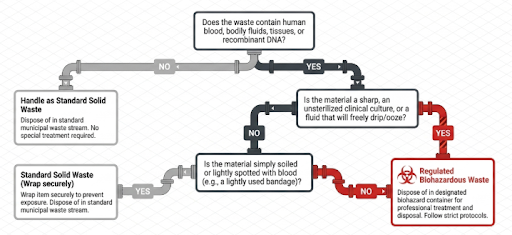
Understand that the biohazard waste must be collected in a special red container. Now, if you want to know what a biohazard container is or what the different biohazard container selection guide is, you can read it in the provided link.
Where Does Biohazard Waste Go After Collection?
Biomedical waste should not be taken straight into a landfill. The waste should first be subjected to “terminal treatment.” This process kills or inactivates infectious pathogens, making the material safe for workers and the environment. The treatment usually consists of;
- Autoclaving: Through the use of high-pressure heat and steam for up to 90 minutes, the bacteria will be eliminated. This is a useful method for microbiological cultures, sharps, and soft biohazardous waste.
- Incineration: Pathological waste, like tissue or animal carcasses, should undergo this destruction process via controlled heat and high-temperature burning. However, this method requires meeting strict EPA air emissions standards to process high-moisture/low-energy waste safely.
These treatments either destroy or eliminate the infectious microorganisms, making it one of the most important parts of the biohazard waste disposal guidelines.
When the biohazard waste has been subjected to terminal treatment, the waste becomes harmless to people and the environment. Later, it will be disposed of in the same way as other municipal solid wastes in a normal landfill or with water. This treatment often makes the process of managing biohazard waste expensive.
The cost of disposing of biomedical waste is ten to twenty-five times higher than that of ordinary municipal trash. The financial aspect shows that the cost of handling biohazard waste is quite expensive. In order to reduce the financial stress on hospitals, the best thing would be to employ a biomedical waste management company.
Biohazard Precautions for Safe Waste Handling
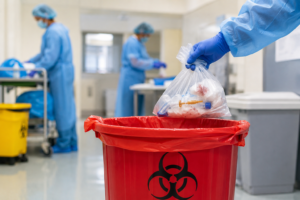
While we know that biohazard waste is known to have adverse effects on human and environmental health, taking biohazard precautions via safe waste handling often makes the process much easier for both healthcare providers and waste management companies. However, many facilities lazily throw general medical waste into red bags, making operational costs drastically inflated.
Some simple precautions the hospital must take care of are;
- Time limits: Waste cannot be stored indefinitely; any storage must be cleared off within 30 days or as soon as odor develops.
- Temperature Control: Pathological waste must always be kept frozen or preserved by keeping it under 42°F. This can safely extend the storage limits for late pickups.
- Security Access: Storage must be kept physically separated from clean supply areas, locked to prevent unauthorized entry, and completely inaccessible to pests.
For administrations, forming a complete compliance ecosystem is vital. Physical safeguards fail without administrative enforcement. True compliance requires continuous oversight across all four of these operational pillars.
Best Practices for Maintaining Biohazard Waste Compliance
Unbroken compliance follows four simple steps to prevent any waste from ecologically harming society or the environment.
- Routine staff training
- Regular waste audits
- Documentation and recordkeeping
- Partnering with certified disposal providers
Routine Staff Training
Step 1: Initial OSHA Alignment
Provide detailed training to your medical staff on the OSHA bloodborne Pathogens Standard (29 CFR 1910.1030). Ensure that a worker only assumes the duties after proper education.
Step 2: Exposure Control Planning
Train your employees on the facility’s specific written exposure control plan, emergency spill response, and exact PPE requirements (gloves, masks, eye protection).
Step 3: Practical Application
Provide ample training on specific bag-sealing techniques like the gooseneck knots, zip ties, and fill-line adherence for sharps containers.
Step 4: Annual Refresher
Mandate yearly updates to reinforce knowledge, cover new regulations, and correct behavioral drift.
Regular Waste Audits
Behavioral deviations are likely without consistent auditing or interventions. This will result in higher costs for disposal, as well as non-compliance with relevant laws. The following three-step method will assist you with auditing your employees’ behavior with respect to biohazard waste disposal guidelines.
- Inspect: Ensure a supervisor conducts routine walkthroughs and visually inspects red bags for non-hazardous solid waste or chemical/radioactive contamination.
- Correct: Address missing supplies, improper labelling, or overfilled sharps containers immediately.
- Optimize: Adjust the placement of the container, removing biohazard bins from low-risk areas, to prevent staff from using them as convenient garbage cans.
Documentations and Recordkeeping
Without any documentation, biohazard trash disposal wasn’t done in the eyes of the EPA and OSHA. Maintain comprehensive records, including the manifests and treatment receipts, for at least three years to comply with state guidelines.
There are 3 documents you must preserve:
- The Generator: Accurate logging of the amount and type of waste generated, properly classified as pathological vs. sharps.
- The Transporter Manifest: A signed transfer document verifying custody exchange with a licensed transporter.
- The Certificate of Destruction: Final document from the treatment facility proving the waste was legally rendered harmless.
Partnering with Certified Disposal Providers
Managing and disposing of all kinds of medical waste through various types of biohazard disposal methods takes up a lot of manpower and monetary commitments. You can handle it all by simply choosing a certified medical waste management service provider.
Remember to check these things before committing to a certified disposal service provider.
- Regulatory Licensing: The vendor must possess active, valid registrations with state environmental agencies and adhere to DOT transport regulations.
- Transparent Manifesting: The vendor must utilize a seamless cradle-to-grave tracking system that automatically provides certificates of destruction.
- Proper Fleet Infrastructure: Vehicles must feature dedicated secondary containment devices and proper hazard placarding.
- Compliance Support: The best practices provide beyond-the-bin services, including OSHA compliance training, HR services, and audit support for facility staff.
Hire a professional partner who helps you manage the technical and legal parts of waste transport. This will allow you to focus entirely on your expertise, that is, patient care.
Conclusion: Managing Biohazard Waste With Safety and Compliance
Proper waste management protects healthcare workers in the U.S. and around the world, keeping communities safe. By correctly identifying waste, handling it with care, and keeping detailed records, you can save your facility money and stay in line with state standards.
Understand that biohazard waste disposal guidelines consist of chained steps from point-of-generation segregations to final landfill integration. Utilize legally compliant containment and protect the human firewall through continuous, OSHA-aligned training. Lastly, treat the paper trail with the same rigor as the physical waste. Vet certified partners thoroughly and maintain unbroken records.
After all, compliance is not an administrative burden, but the structural integrity of your healthcare facility that ensures operational continuity.
FAQs
Who is responsible for handling biohazard waste safely?
Biohazard waste must be handled securely by the “generator” of the waste. The generator here can be defined as the facility where the waste is generated or the lead researcher. They are responsible for ensuring the waste is identified, stored, and treated according to state law.
How often should biohazard waste containers be replaced?
Sharps containers must be permanently closed and replaced after reaching ¾ capacity. For all biohazard waste, Texas law requires it to be stored securely and managed so that it does not create bad odors or infestation sites for pests.
What color bags are commonly used for biohazard waste?
Biohazardous waste must be contained in red bags marked with the international biohazard symbol, which are the standard for infectious waste.
Can biohazard waste be disposed of in regular trash bins?
No, untreated biohazard waste must be kept separate from the regular trash cans. It can only be sent to a landfill after it has been treated and rendered non-infectious.
Why choose Medcycle for biohazard waste disposal services?
The Medcycle Company focuses on waste disposal, mainly in the state of Texas. The company can assist you in saving money by making sure that you dispose of your infectious waste in red bags, which will help you meet all TCEQ rules.