📌 Key Takeaways
Dental amalgam waste contains mercury and must be carefully managed to protect people and the environment. Dental offices generate amalgam waste from unused materials, carving scraps, and removal of old fillings. Because mercury can contaminate waterways and harm ecosystems, the EPA requires dental practices to use appropriate amalgam separators and follow disposal regulations. Proper management includes chairside traps, vacuum filters, secure containers, and recycling through qualified providers. Dental practices should never place amalgam waste in regular trash, red biohazard bags, or drains. Responsible disposal helps maintain compliance while preventing mercury pollution.
Imagine sitting back in the dentist’s chair, hearing the high-pitched hum of the drill as they fix your cavity. Soon, an amalgam filling is placed, making your tooth strong enough to bite into your favorite foods again. But while this procedure saves your smile, it also requires the dentist to properly manage amalgam waste disposal.
The U.S. Food and Drug Administration (FDA) recognizes dental amalgam as a Class II medical device and considers it safe for use on adults and children over 6 years old. However, since June 2017, authorities have been very strict about how dental amalgam waste is disposed of.
This is because fixing a tooth can leave behind tiny “leftover bits” of Amalgam waste. Even though these pieces are smaller than a grain of sand, they can cause enough harm to our trees, vegetation, water, fish, and animals. Ensuring these tiny bits stay where they belong is how dentists show they care for the Earth and all the creatures in it.
What is Amalgam Waste?
A silver-colored liquid that is placed in the gaps between your teeth is an amalgam filling. For so long, this silver liquid has been marketed as a filling that is made up of silver. However, this is a marketing misnomer for a material that is actually made up of 50% liquid neurotoxin (mercury) and only 35% silver, along with other metals such as tin and copper.
It is easy to assume that a filling is permanent, and no waste is left behind. However, in reality, dental offices generate a significant amount of mercury waste worldwide. To understand this, you need to understand the three types of dental amalgam waste generated.
- Non-Contact Waste (Pre-Placement)
- Contact Waste (During Carving)
- Removal Waste (Replacing Old Fillings)
Non-Contact Amalgam Waste
When a dentist prepares to fill a cavity, they use a small sealed capsule in which liquid mercury and metal powder are separately placed. This capsule almost always contains a little more material than needed to ensure the dentist doesn’t run out mid-procedure. This leftover, unused amalgam paste inside the capsule is thrown away as non-contact waste.
Contact Waste
Once the soft amalgam paste is placed into the prepared tooth, a dentist shapes it to match the natural bite of your teeth. These small scraps and shavings of excess material, mixed with your saliva and the water from the dental drill, are sucked up by the high-volume dental vacuum line, which is called contact waste. To resolve this, the clinic needs to follow dental waste management strategies and regulated laws to make themselves compliant with the government and state policies regarding regulated medical waste.
Removal Waste
Amalgam fillings have a reputation for being permanent. However, they are not. They can crack, the tooth around them can get a new cavity, or a patient might choose to replace them with tooth-colored composite. These fillings are also drilled out and sucked into the dental office’s wastewater system.
In short, what begins in your mouth teleports through a labyrinth of plumbing into our municipal wastewater systems, eventually contaminating the global food chain. While a single filling feels small, the collective output of the dental industry is an invisible environmental time bomb. A study stated that the United States alone can produce over 18,159 Kg of non-contact mercury alongside 2763 kg of contact mercury. Even the EPA reports that dentists discharge almost 5.1 tons of mercury annually into publicly owned treatment works (POTW).
Why is Amalgam Waste Regulated?
If you wonder why dental waste disposal is highly regulated, the answer lies in the metal’s nature.
Mercury is a neurotoxin. This means it can poison or destroy the nerve tissue along with the central nervous system. If too much of it gets into our food or water, it can make it very hard for our brains to send important messages to the rest of our bodies.
Since mercury has the potential to become “methylmercury” once it touches the water, there are regulations that have been put in place so that it remains captive and gets recycled. These regulations serve as a trap that makes sure that the mercury used in the dental facility is captured and taken to be recycled.
What are Amalgam Waste Disposal Laws?
Amalgam waste management rules are beyond your local town proceedings; they are a part of a global team effort. A big international treaty called the Minamata Convention was created to help countries all over the world handle mercury safely.
To make this happen, in the U.S. The Environmental Protection Agency (EPA) and the American Dental Association (ADA) work closely together. Here are the most important takeaways from their playbook;
- The 95% Rule: Every dental office is required to use a special filter called a separator that catches at least 95% of the amalgam bits. While 95% is the rule, some “superhero” separators are even stronger, catching up to 99.7%!
- The Deadline: All existing dental offices must ensure their safety systems are in place by July 14, 2020.
- The Report: Dentists must send a “One-Time Compliance Report” to their city. It is like a signed promise that they are protecting the water.
The EPA created a special rule called the Dental Effluent Guidelines (40 CFR Part 441). These ensure tiny particles are caught before they escape into water streams or nature.
How to Dispose of Amalgam Waste?
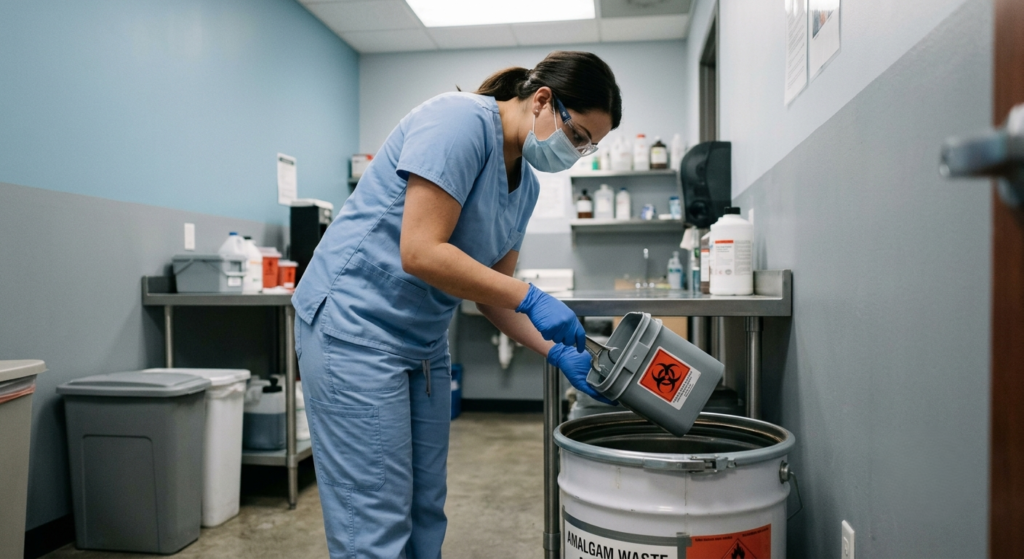
Dental waste collection is like using different-sized nets and catching amalgam waste like fish. Big nets are used to catch big pieces, and super fine nets are used for the tiny ones. The most important tool to catch and clean Amalgam Waste is the Amalgam Separator. This is a high-tech filter that cleans the water before it leaves the office.
It uses two main tricks:
- Sedimentation: This is like letting a handful of sand go in a pool; the heavy metal bits “sink like a stone” to the bottom.
- Centrifugation: This is like a high-speed “merry-go-round” that spins the water so fast that the heavy bits are pushed out to the sides and trapped.
The separator also has a team of “Dry Waste” tools. We call them “dry” because these bits are caught and saved before the water ever leaves the office:
- Chairside Traps: The first line of defense. This is a small screen right at the dental chair that catches the biggest pieces.
- Vacuum Filters: The second safety net. This catches smaller pieces that might have slipped through the first trap.
- Amalgam Buckets: These are special, airtight storage boxes. When a trap or a bit of scrap is ready, it goes into this bucket to wait for its trip to the recycler.
Best Practices: How Medcycle LLC Handles Amalgam Waste Management
Being a “Green” dentist is the only way to stay a hero for the planet. It means following the “Best Amalgam Waste Management Practices” every day to make sure no chemicals or metals end up where they shouldn’t be.
The “Do vs. Don’t” Guide for a Green Office
|
Do |
Don’t |
| Do use pre-filled capsules to prevent accidental spills. | Don’t use “bulk mercury” (pouring it by hand). |
| Do use special line cleaners with a safe pH (6 to 8). | Don’t use bleach (it makes mercury “leak” into the water). |
| Do recycle everything, including extracted teeth with fillings. | Don’t put amalgam in the trash or biohazard “red bags.” |
| Do use chairside traps, vacuum filters, and separators | Don’t rinse devices containing amalgam over drains or sinks |
Following these rules is vital because if amalgam waste is put in a “red bag,” it might be burned. Heat is dangerous because it turns mercury into an invisible poison gas. By recycling instead, we keep the air and water safe.
How to Find the Right Recycling Helper
Dentists don’t recycle the waste themselves; they hire professional Recycling Partners like Medcycle that specialize in picking up the waste and handling it safely.
If you are also looking for a professional recycling partner, look for these key features:
- Approval: A professional medical waste disposal company must use airtight containers that are UN/DOT approved for safe travel.
- Proof: They must provide a “Certificate of Recycling” to prove the waste was handled correctly.
- Mail-back Programs: Many partners let dentists mail their full, sealed buckets to a high-tech facility for recycling.
Conclusion
The journey of a silver filling is quite an adventure! It starts by helping your tooth stay strong and healthy. Once its job is done, it travels through chairside traps, secondary filters, and high-tech separators to make sure it stays out of our environment. Finally, the amalgam waste disposal container reaches a licensed recycling center like Medcycle in Houston, Texas, where it can be handled with care.
By following these simple but important rules, dentists and patients work together like a team of superheroes to keep our water clean and our fish healthy for everyone.
Frequently Asked Questions
What is considered Amalgam Waste?
Amalgam waste includes all “leftover” silver bits, used chairside traps, vacuum filters, and even teeth that have been pulled if they have silver fillings in them.
Can Amalgam be thrown in with general waste?
Strictly no! Amalgam waste disposal must never utilize regular garbage or the biohazard “red bags” because it requires a special recycling home to prevent it from turning into toxic vapor.
What kind of Amalgam Waste container should I use?
For dental waste collection, you must use a special, airtight bucket that is UN/DOT approved and labeled “Dangerous Waste Mercury” and “Toxic.”
How often is Amalgam Waste collected?
Containers are usually collected whenever they are full, but the EPA requires that they be replaced at least every 12 months. By following amalgam waste disposal rules, dentists keep 5.1 tons of mercury out of our water every year. That is a massive win for the environment!